
What HMRC Payroll Information Can the Home Office Access?
From April 2026, UK Visas and Immigration (UKVI) has direct automated access to HMRC Real Time Information (RTI) payroll data. This allows the Home Office to cross-reference actual gross pay, tax deductions, and payment frequencies against the salary and working hours declared on a worker’s Certificate of Sponsorship (CoS) without needing to conduct an initial onsite inspection.
Senior Home Office officials confirmed that automated HMRC data matching is now central to sponsor licence compliance enforcement. Rather than relying solely on physical inspections, UKVI continuously cross-references information held across government departments – including HMRC payroll records and Companies House filings.
Because UKVI can verify whether actual employment practices match declared sponsorship terms remotely, payroll discrepancies can trigger compliance action before an inspector ever steps foot on your premises.
6 Compliance Triggers Under HMRC Data Matching
When automated checks compare HMRC payroll submissions against Sponsor Management System (SMS) records, six primary red flags trigger immediate UKVI scrutiny:
| Risk Area | What UKVI & HMRC Cross-Check | Statutory Requirement / Trigger |
| 1. Salary Discrepancies | Actual gross pay vs. salary declared on the CoS | Paying less than the CoS salary or applicable going rate without a permitted exception. |
| 2. Pay-Period Compliance | Payment frequency and pro-rata earnings per pay cycle | Failing to meet minimum salary thresholds across each individual pay period (weekly/monthly). |
| 3. National Minimum Wage | Hourly earnings vs. contracted working hours | Paying below the UK National Minimum Wage or National Living Wage. |
| 4. Unauthorised Absences | Payroll/attendance gaps vs. SMS activity logs | Failing to report via SMS when a sponsored worker is absent without permission for 10+ consecutive working days. |
| 5. Unpaid or Reduced-Pay Leave | Drops in RTI monthly pay vs. SMS notifications | Failing to report unpaid or reduced-pay absences exceeding 4 weeks in total in a calendar year. |
| 6. Employment Termination | Final P45 / RTI cessation date vs. SMS reporting date | Failing to report the end of a sponsored worker’s employment on the SMS within 10 working days. |
Note: While temporary pay reductions are permitted for statutory family leave or certified sick leave, sponsors must retain clear payroll and HR evidence justifying any drop in RTI figures.
UK Skilled Worker Sponsor Licence Revocation Trends
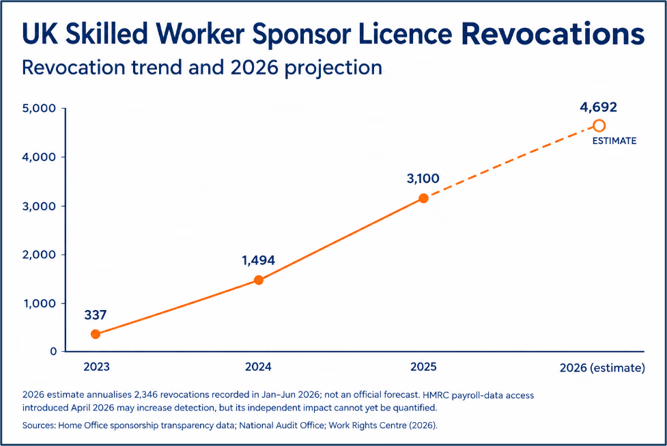
As highlighted in our guide on UK Right to Work Checks, Home Office enforcement has escalated sharply. Official sponsorship transparency data illustrates a steep upward trajectory in enforcement actions:
- 2023: 337 Skilled Worker sponsor licences revoked
- 2024: 1,494 licences revoked
- 2025: ~3,100 licences revoked
- 2026 (Projected): ~4,692 licences estimated based on H1 figures and expanded digital enforcement
With enforcement continuing to intensify – a key theme confirmed at the ILPA Business Immigration Conference – even minor administrative payroll errors or unreported changes in contracted hours can escalate into suspension notices.
How can employers protect their Sponsor Licence?
Employers protect their sponsor licence by running monthly reconciliations between HMRC payroll data, employment contracts, and Certificate of Sponsorship (CoS) records. Aligning HR and payroll teams ensures salary adjustments, unpaid leave, and role changes are assessed for immigration compliance and reported on the SMS within 10 working days.
To minimise the risk of remote compliance triggers and licence revocation, sponsor licence holders should implement four ongoing safeguards:
- Run Monthly Payroll-to-CoS Reconciliations: Regularly compare RTI payroll submissions against every sponsored worker’s CoS salary, contracted hours, and permitted deductions before UKVI flags a mismatch.
- Connect HR, Payroll, and SMS Users: Establish internal sign-off workflows so payroll and line managers never alter a sponsored worker’s hours, salary, or unpaid leave without alerting your Level 1 SMS User first.
- Audit Absence & Reporting Logs: Track cumulative unpaid leave across the calendar year and ensure all mandatory SMS reports are submitted within the strict 10-working-day window.
- Maintain SMS Security & Active Users: Ensure your Level 1 Users comply with mandatory Multi-Factor Authentication (MFA) rules and remain active so vital compliance notifications are never missed.
How Bridge Partners can assist you?
At Bridge Partners, we help UK employers and sponsor licence holders stay ahead of automated Home Office enforcement. Our business immigration team identifies compliance vulnerabilities early, aligns your HR and payroll workflows, and ensures you remain audit-ready at all times:
- Payroll & CoS Reconciliation Audits: Reviewing your RTI payroll records against active Certificates of Sponsorship to resolve discrepancies proactively.
- Mock Home Office Compliance Inspections: Simulating UKVI digital and on-site audits across your Appendix D files and SMS logs.
- HR, Payroll & Key Personnel Training: Practical training sessions covering HMRC data matching, SMS reporting deadlines, and the expanded 2026 right-to-work regime.
Frequently Asked Questions
Q: What HMRC payroll information can the Home Office access from April 2026?
A: UKVI has direct automated access to HMRC Real Time Information (RTI) payroll data. This enables the Home Office to cross-reference actual employee pay, deductions, and pay periods against the salary and hours declared on Certificates of Sponsorship (CoS).
Q: Can the Home Office identify sponsor licence breaches without conducting an onsite compliance visit?
A: Yes. Through automated data matching with HMRC payroll records and Companies House, UKVI can detect salary discrepancies, unreported absences, or employment terminations remotely. This allows the Home Office to issue information requests, conduct digital inspections, or suspend a licence without an initial physical visit.
Q: Does every payroll discrepancy automatically result in sponsor licence revocation?
A: Not necessarily, provided there is a lawful, documented reason for the variance (such as statutory maternity pay or certified sick leave). However, unexplained underpayments or unreported reductions in hours can trigger an investigation, licence downgrade (B-rating), suspension, or full revocation.